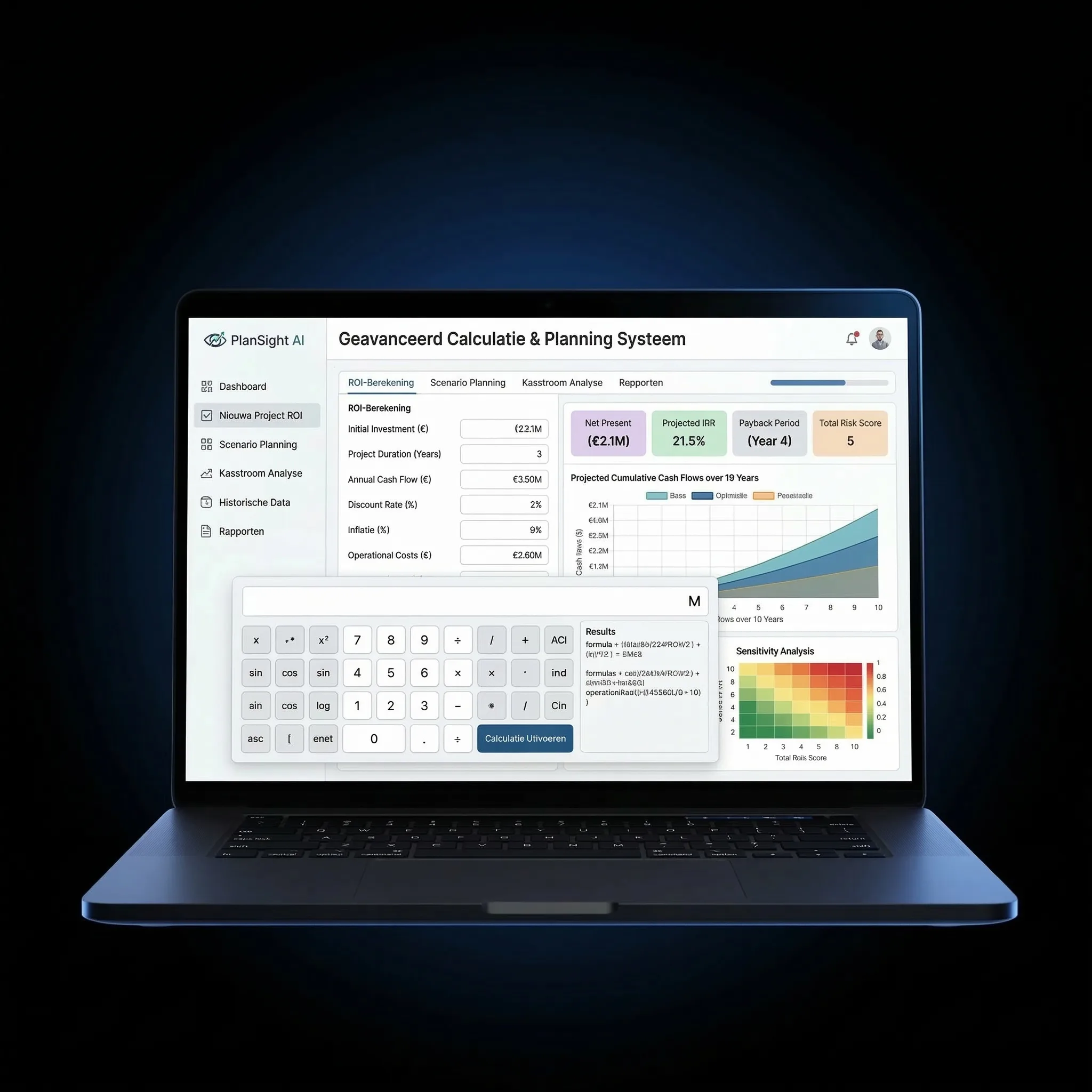
FINANCIAL ENGINE
- FinTech Automation
- Design
- Development

Challenges.
Traditional accounting is plagued by "Monk Work"—manual transcription of receipts, complex VAT calculations, and the delay between transaction and visibility. Businesses require a system that actively manages fiscal compliance and tax obligations, rather than just tracking money.
Solutions.
1. THE FRONTEND (The Command Center): The interface serves as a financial cockpit. Panels include a Real-time KPI Dashboard (Revenue, Gross/Net Profit), Live VAT Tracker (Payable vs Reclaimable), and automated Liquidity & Income Statements. It incorporates Dutch tax rules like MKB-winstvrijstelling for accurate forecasting. 2. THE AUTOMATION ENGINE (n8n & AI Workflows): The "invisible motor" handling Expenses and Invoices. Input Processing: Vision AI absorbs PDFs, Word docs, and JPG receipts, performing OCR even on scans. AI Analysis (The Brain): A GPT-4o class agent extracts dates, totals, and currencies. It performs Smart Categorization (e.g., "Macbook Pro" -> Computer Hardware) to prep depreciation schedules. Complex Fiscal Logic: The AI applies a VAT Decision Tree for Domestic (NL), EU (Intra-Community), and Non-EU transactions. It detects Reverse Charge applicability and sets the correct tax codes automatically. Database: Data is formatted into strict JSON and stored in Supabase with normalized naming conventions.
Results.
- ●95% Time Savings: Uploading is sufficient; no manual data entry required.
- ●Error Elimination: AI precision reduces typo and calculation errors to <0.5%.
- ●Fiscal Certainty: Complex international VAT rules applied consistently and correctly.
- ●Real-time Insight: Administration never lags; financial statements update the second an invoice is uploaded.
Autonomous Fiscal Pipeline
System Architecture
Monthly Expenses (12 months)
Income Statement (YTD)
Liquidity Budget (Q1)
Recent Transactions
Fig 1.0 // Real-time financial supervision interface