
The "Re-Roll" Problem
If you have ever used consumer AI image generators like MidJourney or DALL-E, you know the drill: you write a prompt, wait 15 seconds, and get a result that is about 60% what you wanted. So you adjust the prompt. You add words like "hyper-realistic" or "4k." You regenerate. You get closer. You repeat this process four or five times until you finally get a usable image.
In a consumer setting, a 5-minute creative exploration is fun. In an enterprise production environment, it is deeply unscalable.
If your marketing department needs to generate 4,000 localized variants of a product image for a global ad campaign, you cannot have a designer sitting at a desk hitting the "regenerate" button 15,000 times until the AI finally gets the brand colors right. Root & Logic has engineered a Prompt-Stacking Engine that delivers brand-ready outputs with 90% first-attempt accuracy. This represents the same philosophy behind our AI application development: precision engineering over trial and error.
The Illusion of Automation (Problem Breakdown)
Many agencies and enterprise marketing teams are discovering that "AI image generation" is not the magic bullet they were promised. While the cost of the raw image generation is practically zero, the human labor required to wrangle the AI into producing brand-compliant imagery remains exceptionally high.
The Agency Dilemma:
Consider a global beverage brand launching a new summer campaign. They need the exact same photo of their new bottle, but localized for 50 different countries (different backgrounds, different lighting, different cultural contexts).
- The Ideal AI Scenario: The agency clicks a button and gets 50 perfect images for €2.
- The Reality: The agency clicks the button. The AI makes the bottle slightly too tall in the French version. It changes the exact hex-code of the brand's red label in the Japanese version. It puts six fingers on the hand holding the bottle in the Brazilian version.
A senior art director must now spend three days reviewing, re-prompting, and manually Photoshopping the errors out of the AI's work. The cost savings of using AI evaporate instantly.
The Root Causes: Why Simple Prompts Fail at Scale
Why do powerful models like MidJourney or Stable Diffusion struggle with brand consistency? Because standard prompting is fundamentally flawed as an engineering control mechanism.
1. Interpretation Variance
Language is imprecise. When you prompt an AI with the word "Luxurious," the model has to guess what you mean. Does "luxurious" mean dark mahogany and leather, or does it mean stark, minimalist white marble? The model rolls the dice every single time.
2. Missing Geometric Specifications
A standard text prompt cannot hold enough data to describe complex geometry. If you are generating a specific SKU of a power drill, a text prompt cannot define the exact 147mm × 32mm dimensions of the handle, the exact texture of the rubber grip, and the precise angle of the logo placement. The AI "hallucinates" the details, constantly morphing your product.
3. Brand Drift
When you rely on single prompts across different sessions or different team members, the aesthetic of the generations slowly drifts. By campaign three, the images look subtly different than campaign one, slowly diluting the visual identity of the brand.
Practical Solutions: The Prompt-Stacking Architecture
To achieve enterprise-grade consistency, Root & Logic abandons the "single master prompt." Instead, we utilize an architectural approach called Prompt-Stacking, which layers dozens of specialized, highly-constrained parameter sets on top of each other before the image is even sent to the generation model.
How the Layers Command the Model
Instead of sending one paragraph of text to the AI, our engine sends a mathematically structured matrix:
Layer 1: The Product Geometry Matrix
We do not describe the product with adjectives; we describe it mathematically using ControlNets and depth-maps derived from your CAD files or master photography. The AI is physically restricted from altering the dimensions of your product.
├── Geometry: Cylindrical handle, 147mm × 32mm (Locked via Depth Mask)
├── Materials: Brushed aluminum, black rubber grip
├── Reflective properties: Medium gloss, 0.4 index
└── Color values: #2A2A2A (body), #D4AF37 (accent, strictly enforced)
Layer 2: The Scene & Lighting Specification
Lighting is not left to chance. We define the virtual studio setup with exact coordinate mapping.
├── Background: Gradient #1A1A1A to #0D0D0D
├── Key light: 45° elevation, 30° right azimuth, soft box diffusion
└── Camera virtual lens: 50mm, f/2.8, product-centered frame
Layer 3: Brand Guardrails (Negative Prompting)
It is often more important to tell the AI what not to do.
├── Style keywords: Masculine, premium, sophisticated, brutalist
└── Excluded elements (Weight -2.0): Feminine cues, pastel colors, discount/sale visual language, crowds, clutter
Production Results: The 90% First-Attempt Standard
When these stacked layers are processed through an orchestrated pipeline, the need for human "re-rolling" vanishes.
| Generation Method | First-Attempt Usability | Attempts for Usable Output |
|---|---|---|
| Generic prompt (ChatGPT/MidJourney) | 15-25% | 4-7 attempts |
| Internal "Optimized" prompt guide | 40-55% | 2-3 attempts |
| Root & Logic Prompt-Stacking Engine | 88-92% | 1.1 attempts |
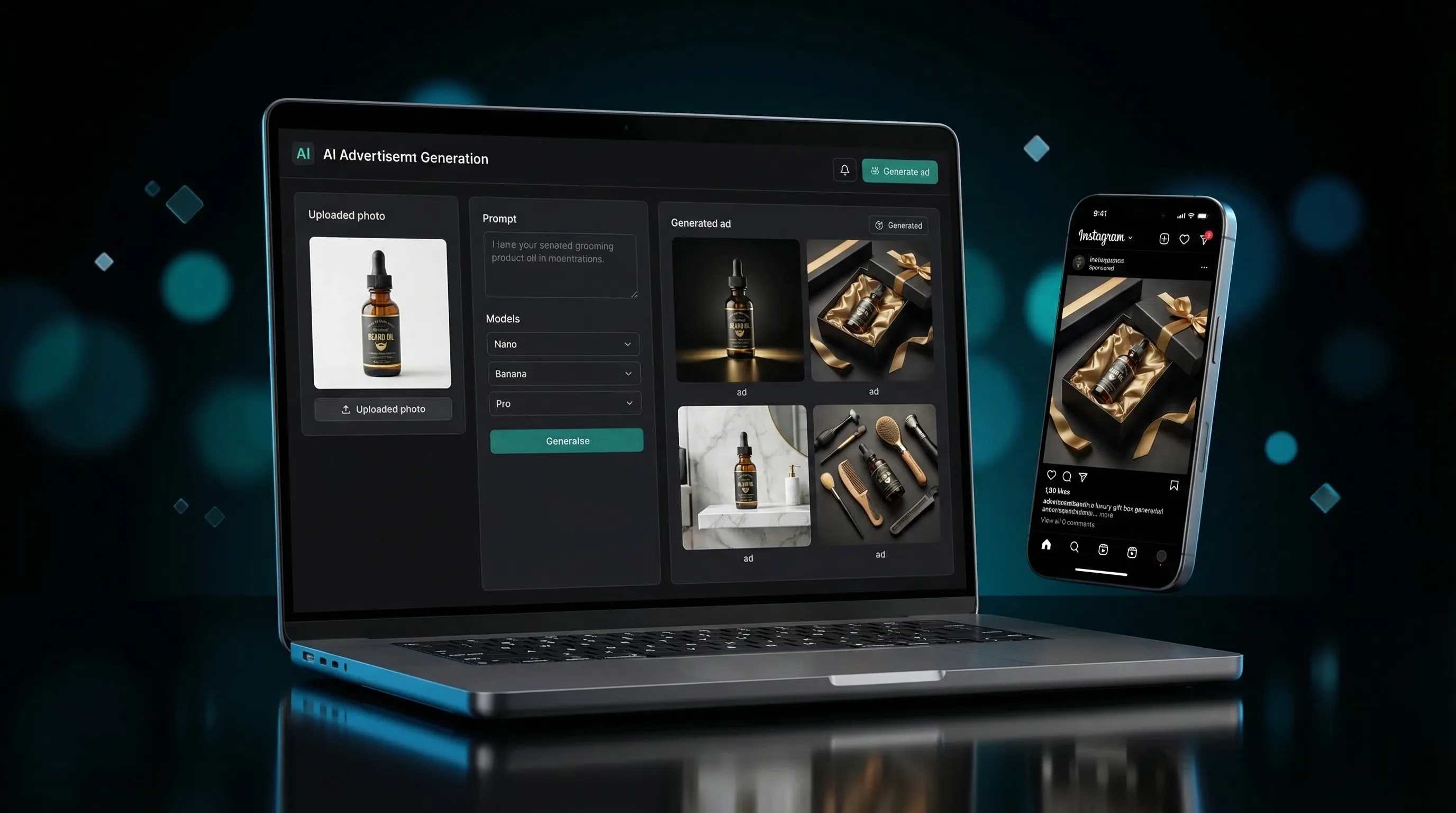
The Unit Economics of [AD-ORCHESTRATOR](/works/ad-orchestrator)
We deployed this exact architecture in AD-ORCHESTRATOR. The result is a total collapse of traditional creative production costs.
* Traditional Agency Production: €400 to €1,200 per final campaign image.
* AD-ORCHESTRATOR Production: AI generation (€0.10) + Human QC review (€0.03) + Compute overhead (€0.02) = €0.15 per final image.
This is a 99.5%+ cost reduction, delivered with higher brand consistency than human-led offshore production.
Beware the Traps: Common Pitfalls in Visual AI
If your team is trying to implement AI image generation internally, watch out for these traps:
* The "Magic Prompt" Document: Relying on a shared Google Doc of "prompts that worked well last time" is a recipe for disaster. As underlying AI models update (e.g., migrating from MidJourney v5 to v6), your "magic prompts" will suddenly produced wildly different, broken results. The logic must be programmatic, not textual.
* Ignoring IP Contamination: If the AI accidentally generates a background element that too closely resembles a competitor's copyrighted product or a living celebrity, you face massive legal liability. Your pipeline must include automated similarity-checks.
* The "Good Enough" compromise: Accepting a slightly off-brand color because "the prompt is too hard to fix" trains your audience to accept a lower quality standard from your brand. Never compromise the core brand assets.
Take Action Today: Visual Automation Checklist
Ready to industrialize your creative output? Run this audit with your marketing team:
- [ ] Calculate the Content Gap: How many visual assets did you want to create last quarter, versus how many you actually created because of budget/time constraints? That gap is your immediate AI ROI opportunity.
- [ ] Define the Immutable Assets: Identify the top 5 visual elements of your brand that can never, ever be altered (e.g., the exact hex code of your logo, the specific angle of your hero product). These must be locked via ControlNets, not text prompts.
- [ ] Audit the Review Time: Ask your art directors to track exactly how many hours per week they spend "reviewing and correcting" external contractor or internal junior designer work. This is the exact labor overhead that Prompt-Stacking eliminates.
- [ ] Map the Variations: List all the platforms, aspect ratios, and localizations required for a standard campaign launch. (e.g., Instagram 1:1, TikTok 9:16, Website Hero 16:9, German translation, French translation). Building the matrix for these variations is the first step in automation.
Strategic Conclusion: Brand Identity as Generative Logic
In the age of AI, your brand identity is no longer a static PDF file stored on a server. It must become a generative, mathematical logic.
Agencies and brands that continue to rely on manual prompting and infinite "re-rolling" will be crushed by the sheer volume and speed of competitors utilizing structured generation pipelines. By turning visual direction into code, you achieve what was previously impossible: infinite scale with zero degradation in quality.
Learn how scaling without proportional cost increases makes this level of automated production not just viable, but strategically necessary.
Stop re-rolling prompts. Contact Root & Logic for an AD-ORCHESTRATOR demonstration today.